Showing posts with label health. Show all posts

Saturday, March 31, 2012

Want to live to 100? And stay healthy too!


I have received this rather long article from a practising medical doctor friend, Abdullah Daud and thought maybe it will be good for my blog readers as well.

11 Habits That Will Help You Live to 100
Healthy Steps to a Longer Life


One of the biggest factors that determines how well you age is not your genes but how well you live. Not convinced? A study published in 2009 in the British Medical Journal of 20,000 British folks shows that you can cut your risk of having a stroke in half by doing the following things: being active for 30 minutes a day, eating five daily servings of fruit and vegetables, and avoiding cigarettes and excess alcohol.
While those are some of the obvious steps you can take to age well, researchers have discovered that centenarians tend to share certain traits in how they eat, move about, and deal with stress—the sorts of things we can emulate to improve our own aging process. Of course, getting to age 100 is enormously more likely if your parents did. Still, Thomas Perls, who studies the century-plus set at Boston University School of Medicine, believes that assuming you've sidestepped genes for truly fatal diseases like Huntington's, "there's nothing stopping you from living independently well into your 90s." Heck, if your parents and grandparents were heavy smokers, they might have died prematurely without ever reaching their true potential lifespan, so go ahead and shoot for those triple digits. Follow these 11 habits and check out Perls' lifetime risk calculator to see how long you can expect to live.

1. Don't Retire
"Evidence shows that in societies where people stop working abruptly, the incidence of obesity and chronic disease skyrockets after retirement," says Luigi Ferrucci, director of the Baltimore Longitudinal Study of Aging. The Chianti region of Italy, which has a high percentage of centenarians, has a different take on leisure time. "After people retire from their jobs, they spend most of the day working on their little farm, cultivating grapes or vegetables," he says. "They're never really inactive." Farming isn't for you? Volunteer as a docent at your local art museum or join the Experience Corps, a program offered in 19 cities that places senior volunteers in urban public elementary schools for about 15 hours a week.

2. Floss Every Day
That may help keep your arteries healthy. A 2008 New York University study showed that daily flossing reduced the amount of gum-disease-causing bacteria in the mouth. This bacteria is thought to enter the bloodstream and trigger inflammation in the arteries, a major risk factor for heart disease. Other research has shown that those who have high amounts of bacteria in their mouth are more likely to have thickening in their arteries, another sign of heart disease. "I really do think people should floss twice a day to get the biggest life expectancy benefits," says Perls.

3. Move Around
"Exercise is the only real fountain of youth that exists," says Jay Olshansky, a professor of medicine and aging researcher at the University of Illinois at Chicago. "It's like the oil and lube job for your car. You don't have to do it, but your car will definitely run better." Study after study has documented the benefits of exercise to improve your mood, mental acuity, balance, muscle mass, and bones. "And the benefits kick in immediately after your first workout," Olshansky adds. Don't worry if you're not a gym rat. Those who see the biggest payoffs are the ones who go from doing nothing to simply walking around the neighborhood or local mall for about 30 minutes a day. Building muscle with resistance training is also ideal, but yoga classes can give you similar strength-training effects if you're not into weight lifting.

4. Eat a Fiber-Rich Cereal for Breakfast
Getting a serving of whole-grains, especially in the morning, appears to help older folks maintain stable blood sugar levels throughout the day, according to a recent study conducted by Ferrucci and his colleagues. "Those who do this have a lower incidence of diabetes, a known accelerator of aging," he says.

5. Get at Least Six Hours of Sleep Each Night
Instead of skimping on sleep to add more hours to your day, get more to add years to your life. "Sleep is one of the most important functions that our body uses to regulate and heal cells," says Ferrucci. "We've calculated that the minimum amount of sleep that older people need to get those healing REM phases is about six hours." Those who reach the century mark make sleep a top priority.

6. Consume Whole Foods, Not Supplements
Strong evidence suggests that people who have high blood levels of certain nutrients—selenium, beta-carotene, vitamins C and E—age much better and have a slower rate of cognitive decline. Unfortunately, there's no evidence that taking pills with these nutrients provides those anti-aging benefits. "There are more than 200 different carotenoids and 200 different flavonoids in a single tomato," points out Ferrucci, "and these chemicals can all have complex interactions that foster health beyond the single nutrients we know about like lycopene or vitamin C." Avoid nutrient-lacking white foods (breads, flour, sugar) and go for all those colorful fruits and vegetables and dark whole-grain breads and cereals with their host of hidden nutrients.

7. Be Less Neurotic
It may work for Woody Allen, who infuses his worries with a healthy dose of humor, but the rest of us neurotics may want to find a new way to deal with stress. "We have a new study coming out that shows that centenarians tend not to internalize things or dwell on their troubles," says Perls. "They are great at rolling with the punches." If this inborn trait is hard to overcome, find better ways to manage when you're stressed: Yoga, exercise, meditation, tai chi, or just deep breathing for a few moments are all good. Ruminating, eating chips in front of the TV, binge drinking? Bad, very bad.

8. Live Like a Seventh Day Adventist( just an example and article written for American )
Americans who define themselves as Seventh Day Adventists have an average life expectancy of 89, about a decade longer than the average American. One of the basic tenets of the religion is that it's important to cherish the body that's on loan from God, which means no smoking, alcohol abuse, or overindulging in sweets. Followers typically stick to a vegetarian diet based on fruits, vegetables, beans, and nuts, and get plenty of exercise. They're also very focused on family and community.

9. Be a Creature of Habit
Centenarians tend to live by strict routines, says Olshansky, eating the same kind of diet and doing the same kinds of activities their whole lives. Going to bed and waking up at the same time each day is another good habit to keep your body in the steady equilibrium that can be easily disrupted as you get on in years. "Your physiology becomes frailer when you get older," explains Ferrucci, "and it's harder for your body to bounce back if you, say, miss a few hours of sleep one night or drink too much alcohol." This can weaken immune defenses, leaving you more susceptible to circulating flu viruses or bacterial infections.

10. Stay Connected
Having regular social contacts with friends and loved ones is key to avoiding depression, which can lead to premature death, something that's particularly prevalent in elderly widows and widowers. Some psychologists even think that one of the biggest benefits elderly folks get from exercise the strong social interactions that come from walking with a buddy or taking a group exercise class. Having a daily connection with a close friend or family member gives older folks the added benefit of having someone watch their back. "They'll tell you if they think your memory is going or if you seem more withdrawn," says Perls, "and they might push you to see a doctor before you recognize that you need to see one yourself."

11. Be Conscientious
The strongest personality predictor of a long life is conscientiousness—that is, being prudent, persistent, and well organized, according to The Longevity Project, coauthored by Howard Friedman and Leslie Martin. The book describes a study that followed 1,500 children for eight decades, collecting exhaustive details about their personal histories, health, activities, beliefs, attitudes, and families. The children who were prudent and dependable lived the longest, Friedman says, likely because conscientious types are more inclined to follow doctors' orders, take the right medicines at the right doses, and undergo routine checkups. They're also likelier to report happier marriages and more satisfying work lives than their less conscientious peers.

Thank you for trying to take care of your goodselves even though if you have skipped a lot;).

Have a good weekend!


Saturday, December 31, 2011

Honey


Both the holy Qur'an and Hadith refer to honey as a healer of disease.

'Your Lord revealed to the honeybee: make home in the hills, on the trees and in the structures they raise' 016:068
'Then eat all the fruits, then go along the pathways of your Lord create easy for you, from their bellies come a drink of varying colours, in which there is cure for mankind. Verily in that there is Sign for people who ponders'. 016:069

In addition, the Prophet (PBUH) said:

'Honey is a remedy for every illness and the Qur'an is a remedy for all illness of the mind, therefore I recommend to you both remedies, the Qur'an and honey.' (Bukhari)

The above hadith or Tradition and the benefit of honey can be read from islamicsites.com/honey.asp by Dr. Monzur Ahmed.

Honey used to be a must buy item whenever I have a chance to go and see my late father in KT. I normally buy about ten bottles of honey and whenever he still have some bottles honey to spare he asked me to bring a bottle back to KL for my own consumption. He normally add two tablespoons of honey to a small glass of 'cool boiled water', he stirs up the mixture and consumes it twice a day once in the morning and once in the evening. The other must buy item is 'minyak afiat' , an ointment that he used to massage himself before and after sleep.

One fine day, my brother-in- law came to our house in search of pure honey. I was in Sudan then and we have a few bottles of honey that I brought back from Sudan. He took the honey I bought from Trengganu and also those from Sudan. BIL told us later that one of his nieces got a weird sickness.. The boy's stomach got swollen in the evening ( but not any other time though) after he played in one awkward corner of a play-ground in Klang. After many unsuccessful medical treatments, my BIL was recommended to see a Tabligh guy who originates from Middle East in Masjid India here in KL. The guy asked for pure honey as the only ingredient for him to try to cure the boy's sickness.

BIL has bought many bottles of honey from Klang and KL markets but the tabligh guy told him that those honey were not pure enough for him to use. When he brought the many bottles of honey from my house.. The guy said the honey I normally bought in KT for my late father was good enough. We were glad to note that the boy weird sickness has been cured and the honey I bought in KT received some sort of authentification ;)

Now that my father is no longer around I still buy ten bottles of honey from KT once in a blue moon for my own consumption. Sometime I sold some bottles of the honey to my friends who knew about its quality and of late one of my friend paid better price than what I asked him to pay ... saying that it not fair for him to buy the honey at such a low price..;).

I used to sell kain batik and sutera some fifteen years ago to top up the payment of my car installment. I was at time scolded by my siblings for being so 'tamak' or greedy but honestly it was not so much for money now.. It is just a small past time.. I told them I can not even expect to pay a small portion of fuel cost of travelling to KT from KL from the sale of few bottles of honey ;)..

I believe this is my last entry for 2011 and I sincerely want to ask for forgiveness from my dear blog readers and those blogs owners that I commented for any unpleasantness felt from any of my actions..

Wishing you a Happy New Year with or without a bang from Ayoh Wang and family.
May the new year bring the blessing of Our Creator, His Forgiveness and His Pleasure.


Thursday, December 1, 2011

Nutrition: Myths vs Facts

A few months ago, I got this material under almost the same title presented by a well-known Malaysian dietitian from a reputable medical centre. I asked for permission to put the article on my blog and was told to modify it. I post a slightly modified version here for the benefit of my kind and appreciative blog readers, some at times wrote about their need to go on diet regime.

IS IT TIME FOR THE LATEST FAD DIET?
1. Overweight is becoming increasingly common in our country..
2. more than 20% adults are estimated to be overweight.
3. Do weight control diets actually delivered their promises?
4. How do you rank your weight control strategies?

HOW TO SPOT FAD DIETS?
1. Promote quick weight loss : 0.5 to 1 kg per week.
2. Promote miracle or mmagic food
3. Drinking cabbage soup everyday or eating only fruits for breakfast
4. Restrict or eliminate certain food group
5. High Protein Low Carbs Diet and No rice is allowed
6. Use testimonials from famous people & tie the diet to well-known cities
7. Beyoncé Maple Syrup Diet
8. The Beverly Hills Diet.


They are often expensive supplements!
1. Imply as cure-alls & work for everyone.
2. Claim that weight can be lost and maintained without exercise and other lifestyle changes.
3. No scientific research to back up claims.
4. Encourage people to look outside the medical establishment for correct advice.

PubMed indexes paper published from over 30,000 journals.
-A search for articles on Diet & Obesity finds more than 30,000 articles
So What’s The Best Diet Anyway?


GO FOR …..
1. Regular Exercise -Sensible and Safe
2. Commit yourself to a regular exercises program.

FORGET Crash & Fad Diets
1. No value to long term weight control
2. Short term losses are usually regained
3. Long term use can be harmful


FORGET Electronic Gadgets
1. No value to weight loss
2. No extra energy is used

FORGET Massage Belts, Sauna,Chemical Bandage Wraps
1. No value in weight loss.
2. Fat is not “melted” or broken down.
3. Fluid losses are soon replaced when water is drunk


FORGET Cellulite Treatments
1. “Cellulite” is nothing but plain fat.
2. Normal dietary measures with regular physical activity is the only sensible approach.
3. Avoid gimmicky devices and expensive treatment

FORGET Diuretics & Laxatives
1. Excessive use can endanger health.
2. They don’t aid fat loss !

Setting Realistic Goals
1. Don’t be overwhelmed with tremendous amount of weight to loose.
2. Break into smaller, more achievable short-term goals.
3. Genetics plays a key role in determining our body makeup.
4. Learn to love the body you have & keep your focus on ways to make it healthy !

L.The ScalesCan Drive You Nuts !
1. Don’t let the day-to-day fluctuations throw you into a state of panic.
2. Limit amount of times you weigh yourself.

Get Moving and Keep Moving
1. Exercise helps promote weight loss and weight maintenance.
2. Exercise relieves stress and can even psych up your state of mind to motivate you to make the smart food choices.

THE BOTTOM LINE……..
“For a lasting and healthful weight loss = a varied diet, reduced calorie intake and regular physical activity”.

Maintain a Healthy Weight and be Physically Active
A body mass index (BMI) of 18.5 – 25 is recommended.
Healthy weight results from a balance of calories (energy) in and energy expended.

Small, everyday changes matter most


Gradually transition from the old high calories plate...


to a better plate...


to a 3/4 plant-based food+ 1/4 animal protein


Eat Plenty of Vegetables, Fruits, Grains and Legumes
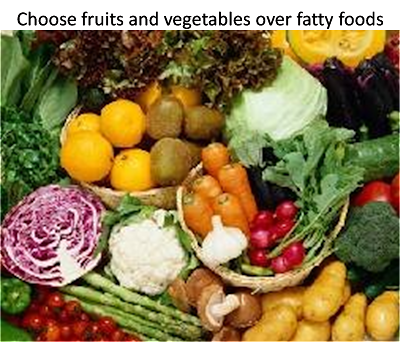
1. Eat 5 - 9 servings daily
2. Eat a variety of fruits and veggies; choose 100% juices.
3. Include dark green and orange vegetables, as well as dry beans and peas each week.
4. Enjoy whole grains, beans and peas with each meal
Do these foods prevent cancer?
Soy foods
1. Contain phytochemicals that may fight cancer (based on animal studies).
2. Soy supplements should not be taken to reduce cancer risk.
3. Women with breast cancer should consume only moderate amounts of soy. Source: The Complete Guide to Nutrition and Physical Activity.
The American Cancer Society. www.acs.org.


Tea
Some research (animal studies)
suggests that tea may have
antioxidant properties and
prevent cancer. Studies in humans
have been less conclusive.

The bottom line
1. Maintain a healthy weight throughout life
2. Adopt a physically active lifestyle
3. Eat a healthy diet, with emphasis on plant sources
4. If you drink alcoholic beverages, limit consumption
5. Focus on the overall content of your diet rather than specific nutrients
6. Don’t just take vitamin supplements to prevent disease


Hopefully some of you might benefit from this entry.


Thank you & Have a nice diet day !

Sunday, October 9, 2011

Stay Young My Friend

This post is inspired by a Canadian friend I have yet to meet, Uncle Lee (he blogs here)
However I owe this post to another e-mail group friend, Mohd Jamin Lebai Din ;).

We all need to read this one over and over until it becomes part of who we are!

HOW TO STAY YOUNG

1. Try everything twice.
On one woman's tombstone she said she wanted this epitaph:
"Tried everything twice. Loved it both times!"

2. Keep only cheerful friends.
The grouches pull you down.
(Keep this in mind if you are one of those grouches!)

3. Keep learning:
Learn more about the computer, crafts, gardening, whatever...
Never let the brain get idle.'An idle mind is the devil's workshop.'
And the devil's name is Alzheimer's!

4. Enjoy the simple things.

5. Laugh often, long and loud.
Laugh until you gasp for breath.
And if you have a friend who makes you laugh,
spend lots and lots of time with HIM/HER.

6. The tears happen:
Endure, grieve, and move on.
The only person who is with us our entire life, is ourselves.
LIVE while you are alive.

7. Surround yourself with what you love:
Whether it's family, pets, keepsakes, music, plants, hobbies, whatever..
Your home is your refuge.


8. Cherish your health:
If it is good, preserve it.
If it is unstable, improve it.
If it is beyond what you can improve, get help.

9. Don't take guilt trips..
Take a trip to the mall, even to the next county,
to a foreign country, but NOT to where the guilt is.
10. Tell the people you love that you love them, at every opportunity.
I love you, my special friend.


11. Forgive now those who made you cry. You might not get a second chance..

And if you don't send this to at least 4 people - who cares?
But do share this with someone.

Remember! Lost time can never be found.

Be kinder than necessary, for everyone you meet is fighting some kind of battle.

Have a great day!
MY BEAUTIFUL, WONDERFUL FRIENDS!!!!!!!!!!

Monday, October 3, 2011

All you need to know about oils


Oops! I am not about to bore you with those hydrocarbons. Although I am in oil and gas industry but I am not going to talk about that oil.. I have received an interesting article on oils that are closer to us - our stomachs.

Gone are the days when all you had to do was choose between sunflower or olive oil. Now it seems you can buy the oil from just about every plant, nut or seed out there but should we be adding them to our stir fries or drizzling them over our salads?

Find out at a glance guide to 9 of the best.

Best oils to cook with

Top rated - rapeseed oil
Rapeseed oil contains omegas 3, 6 and 9, essential fatty acids so it's great for heart health, brain health and joint mobility. It is also a rich, natural source of vitamin E — essential for healthy skin and a strong immune system. High in mono-unsaturated fats and with less than half the cholesterol raising, saturated fats of olive oil.. it is one of the few natural oils that can be heated to deep-frying temperature without its antioxidants, character, colour and flavour spoiling. In short, one of the best oils there is and what's more — some of the very best rapeseed oils are produced right here (the clue) in Britain.

Best all rounder - olive oil
Olive oil is a great source of heart protecting, cholesterol lowering, monounsaturated fat as well as free radical fighting antioxidants known to protect the body against premature aging and cancer. It can be used to cook with up to temperatures of 180 degrees and is mild enough in flavour to be used with most dishes. However, extra virgin olive oil (the oil that is extracted from the first press) is not quite so stable so it is best used cold.

Best for tight budgets - sunflower oil
Cheap, easy to find and a great source of the free radical fighting antioxidant - vitamin E. In fact, just 1-2 tablespoons contains all your daily requirement. It is also a good source of cholesterol reducing omega 6 polyunsaturates. However, it contains very few omega 3's so if you use sunflower oil regularly, you need to be sure you're getting enough omega 3s in your diet from other sources to balance things out. A chemically stable oil, it is suitable for deep-frying but don't be tempted to re-use the oil more than a couple of times as re-heating it to high temperatures can result in the formation of trans fatty acids known to raise cholesterol and increase the incidence of some cancers.

Best for high temperatures - groundnut oil
Ground nut oil — sometimes called peanut oil has a high smoking point making it ideal roasting, making Yorkshire puddings or frying. It is an excellent all-rounder and has a very neutral, light flavour perfect for use in oriental dishes that often combine quite delicate flavours. Do be careful though as this oil is made from peanuts so anyone with a nut allergy should steer well clear.

Best for adding flavour - sesame oil
Another great source of cholesterol lowering omega 6 fatty acids light sesame oil can be used for deep frying and the dark or heavy sesame oil (made from roasted sesame seeds) adds a delicious rich flavour to stir-fried meats or vegetables. Used a lot in oriental dishes it's rich flavour works as a seasoning in itself.

Best for rice dishes - avocado oil
Avocado oil has very little if any omega three fatty acids but it is a great source of monounsaturated fats and is also rich in skin enhancing vitamin E. It has a slightly nutty flavour that is delicious drizzled over salads or rice dishes. However, it can also be used to cook with as it has a higher smoking point than many oils so it's fine to grill, sauté or stir-fry with it.

Best oils for dressings, drizzling and dipping
Top rated - walnut oil
A delicious, aromatic, nutty oil that is a good source of omega three fatty acids and tastes delicious (used as a dip along side a good balsamic vinegar) as a dip for freshly torn, warm breads for warm breads. It's also great for drizzling over salads and risottos and goes really well with white fish, meat, mozzarella and goat's cheese. However, this oil tends to become bitter when cooked and can go off very quickly so buy in small quantities and store in a cool, dark place.

Best for vegetarians - linseed oil
Linseed oil is a much richer source of omega 3 than any other oil and a great choice for strict vegetarians who need to get omega 3 fatty acids solely from plant foods. Omega three fatty acids help to lower the risk of heart disease and stroke, increase concentration (particularly in children), alleviate the symptoms of inflammatory conditions such as rheumatoid arthritis and they may also help prevent Alzheimer's. Linseed oil however, is not suitable for cooking as heat can make it taste bitter and it can quickly become rancid if it is not stored correctly (in a cool dark place). Studies show that if this happens the benefits are negated and possibly reversed.

Best for drizzling - hazelnut oil
Hazelnut oil is a great source of Vitamin E which helps to maintain a heart health, good skin, a healthy reproductive system and a strong immune system. Fairly pricey and not so readily available as many other oils it is worth seeking out either from your local health food store or on line to drizzle over salads, rice dishes or fresh pasta adding a delicious, subtle, nutty flavour.

This post was uploaded from an article from my e-mail group posted by Zubia Kiran.

Now you may wonder why our own beloved coconut oil and our palm oil are not listed here.. your guess is as good as mine.. this article was probably written by those who do not appreciate our palm oils... Yes! it is from Britain ;)

It is not that I am not patriotic or something .. I am too busy trying to find the other oil.

Have a good day.


Sunday, August 21, 2011

WHEN TO DRINK MORE WATER

Semasa semua dok ghairah menikmati ramadhan dan yang sewaktu dengannya suka lah saya mengalihkan sedikit pandangan ke arah yang tak kurang penting. supaya kesihatan kalian terpelihara.

I have upload a posting from my egroup mail friend Hamdan Idris who forwarded this article..

I knew water is important but I never knew about the special times to drink it.

Did you??


Drinking water at the correct time maximizes its effectiveness on the Human body :

2 glasses of water after waking up - helps activate internal organs


1 glass of water 30 minutes before a meal (not after!) - helps digestion

1 glass of water before taking a bath - helps lower blood pressure

1 glass of water before going to bed - avoids stroke or heart attack


Hope it is of benefit to you

Selamat Hari Raya ..Kullu am bikhair

Friday, July 1, 2011

Microwave- Why did the Russians Ban an Appliance Found in 90% of American Homes?


Today marked my second 2 year contract with PCSB... Alhamdulillah


This entry is in response to one of the comment on my last posting. I only download a part of a rather long article that can be read here (only for those with time to spare). If you do not have time to read the full entry here and just like to browse through you can read the sentences in bold and in red fonts.

If you also prefer to read something similar in Bahasa you can read it here.

Whatever you do please note that numerous researches on the subjects has been conducted and their conclusion can not be all wrong.. Happy reading /browsing!!

Convenience Comes at Significant Toxic Threat to You and Your Family
However, according to Powerwatch, a non-profit independent organization with a central role in the microwave radiation debate:
Even when the microwave oven is working correctly, the microwave levels within the kitchen are likely to be significantly higher than those from any nearby cellular phone base-stations. Remember also that microwaves will travel through walls if the microwave oven is against an inside wall.”
New Study Confirms Microwaves Affect Your Heart
Dr. Magda Havas of Trent University says:
“This is the first study that documents immediate and dramatic changes in both heart rate and heart rate variability caused by an approved device that generates microwaves at levels well below (0.3 percent) federal guidelines in both Canada and the United States.”
No longer can skeptics claim that microwaves produce no immediate biological effects at ordinary household levels!


Microwaving Also Zaps the Nutrients Right Out of Your Food
The handful of studies that have been done generally agree, for the most part, that microwaving food damages its nutritional value. Your microwave turns your beautiful, organic veggies, for which you’ve paid such a premium in money or labor, into “dead” food that can cause disease!


How Your Microwave Actually Heats Your Food
Microwaves are a form of electromagnetic radiation—waves of electrical and magnetic energy moving together through space. EM radiation ranges from very high energy (gamma rays and x-rays) on one end of the spectrum to very low energy (radio waves) on the other end of the spectrum.
Microwaves are on the low energy end of the spectrum, second only to radio waves. They have a wavelength of about 4.8 inches—about the width of your head.
Microwaves are generated by something called a magnetron (a term derived from the words “magnet” and “electron”), which is also what enabled airborne radar use during WWII. Hence the early name for microwave ovens: radar ranges.
A magnetron is a tube in which electrons are subjected to both magnetic and electrical fields, producing an electromagnetic field with a microwave frequency of about 2,450 megaHertz (MHz), which is 2.4 gigaHertz (GHz).
Microwaves cause dielectric heating. They bounce around the inside of your oven and are absorbed by the food you put in it. Since water molecules are bipolar, having a positive end and negative end, they rotate rapidly in the alternating electric field. The water molecules in the food vibrate violently at extremely high frequencies—like millions of times per second—creating molecular friction, which heats up the food.
If the food or object place in the microwave had no water it would not be able to have this resonance heating type effect and would remain cool. Or, as investigative journalist William Thomas calls it, “electrical whiplash.”
Structures of the water molecules are torn apart and forcefully deformed. This is different than conventional heating of food, whereby heat is transferred convectionally from the outside, inward. Microwave cooking begins within the molecules where water is present.
Contrary to popular belief, microwaved foods don’t cook “from the inside out.” When thicker foods are cooked, microwaves heat the outer layers, and the inner layers are cooked mostly by the conduction of heat from the hot outer layers, inward.
Since not all areas contain the same amount of water, the heating is uneven.
Additionally, microwaving creates new compounds that are not found in humans or in nature, called radiolytic compounds. We don’t yet know what these compounds are doing to your body.
In addition to the violent frictional heat effects, called thermic effects, there are also athermic effects, which are poorly understood because they are not as easily measured. It is these athermic effects that are suspected to be responsible for much of the deformation and degradation of cells and molecules.

As an example, microwaves are used in the field of gene altering technology to weaken cell membranes. Scientists use microwaves to actually break cells apart. Impaired cells then become easy prey for viruses, fungi and other microorganisms.8
Another word for these athermic effects is the “microwave effect,” a subject of controversy that I’ll get into a bit later.


Microwave Sickness
When your tissues are directly exposed to microwaves, the same violent deformations occur and can cause “microwave sickness.”
According to Professor Franz Adelkofer, a leading scientist in the area of biological effects of EMF fields:
"There is real evidence that hyperfrequency electromagnetic fields can have geno-toxic effects. And this damaged DNA is always the cause of cancer.
We’ve found these damaging effects on the genes at levels well below the safety limits. That’s why we think it’s urgent to base our safety limits on the biological effects, not the thermic ones.
They should be based on biology, not on physics.”


Twenty Years of Russian Research Supports Microwave Concerns
The Nazis are credited with inventing the first microwave-cooking device to provide mobile food support to their troops during their invasion of the Soviet Union in World War II. These first microwave ovens were experimental. After the war, the US War Department was assigned the task of researching the safety of microwave ovens.
But it was the Russians who really took the bull by the horns.
After the war, the Russians had retrieved some of these microwave ovens and conducted thorough research on their biological effects. Alarmed by what they learned, the Russians banned microwave ovens in 1976, later lifting the ban during Perestroika.
Twenty years of Russian research (and German studies as far back as 1942 Berlin) make a strong argument against the safety of microwave cooking.
The Powerwatch article cited above summarizes the Russian research quite well, which I will duplicate below.
· Russian investigators found that carcinogens were formed from the microwaving of nearly all foods tested.
· The microwaving of milk and grains converted some of the amino acids into carcinogenic substances.
· Microwaving prepared meats caused the formation of the cancer-causing agents d-Nitrosodienthanolamines.
· Thawing frozen fruits by microwave converted their glucoside and galactoside fractions into carcinogenic substances.
· Extremely short exposure of raw, cooked or frozen vegetables converted their plant alkaloids into carcinogens.
· Carcinogenic free radicals were formed in microwaved plants—especially root vegetables.
· Structural degradation leading to decreased food value was found to be 60 to 90 percent overall for all foods tested, with significant decreases in bioavailability of B complex vitamins, vitamins C and E, essential minerals, and lipotropics (substances that prevent abnormal accumulation of fat).
I might add that this finding is supported by the 1998 Japanese study by Watanabe about vitamin B12 in milk, cited above.

The Swiss Clinical Study: Hans Hertel
Some fairly compelling evidence supporting the destructive effects of microwaves comes from a highly cited study by a Swiss food scientist named Hans Hertel. Dr. Hertel was the first scientist to study the effects of microwaved foods on the blood and physiology of human beings.
His small study, coauthored by Dr. Bernard Blanc of the Swiss Federal Institute of Technology and the University Institute for Biochemistry, revealed the degenerative forces produced by microwave ovens on the foods they cooked.
Dr. Hertel concluded that microwave cooking changed the nutrients in the food, and that changes took place in the blood that could cause negative health effects.
Hertel’s conclusions were that microwaving food resulted in:
· Increased cholesterol levels
· Decreased numbers of leukocytes (white blood cells), which can suggest poisoning
· Decreased numbers of red blood cells
· Production of radiolytic compounds
· Decreased hemoglobin levels, which could indicate anemia

Not surprisingly, Dr. Hertel's study was met with great resistance from those with much to lose.
A gag order against Dr. Hertel was issued by a Swiss trade organization in 1992, which was later removed in 1998. But an American journalist, Tom Valentine, published the results of Hertel’s study in Search for Health in the spring of 1992.
Hertel wrote:
“There are no atoms, molecules, or cells of any organic system able to withstand such a violent, destructive power for any period of time. This will happen even given the microwave oven’s low power range of milliwatts.”

And then there is the issue of biophotons.
Possible Microwave Effects on Your Biophotons
Biophotonics is the study, research, and applications of photons in their interactions within and on biological systems. Much of the work in the area of biophotons was done in Germany. Dr. Dietrich Klinghardt discusses biophotons in our 2008 interview.
Biophotons are the smallest physical units of light that are stored in and used by all biological organisms—including you. Vital sun energy finds its way into your cells via the food you eat, in the form of these biophotons.
Biophotons contain important bio-information and are very important to many vital processes in your body. They are partly responsible for your feeling of vitality and well-being. You gain biophotons by eating foods rich in them, such as naturally grown fresh vegetables and sun-ripened fruits, which are rich in light energy.
The more light energy a food is able to store, the more nutritious it is.
If the “microwave effect” exists (as you shall see, there is a huge amount of evidence that it does), then microwaves can potentially destroy biophotons in the same way that it alters other structures, rendering your food dead and lifeless.
It seems quite plausible that microwaves could disrupt or destroy biophotons, since they are capable of breaking apart DNA bonds!
As far as I can find, there haven’t been any studies of the direct effects of microwave radiation on biophotons, but it seems like an important angle of investigation for the future.
Long-Term Effects of Exposure to Non-Ionizing Radiation
One of the basic controversies about the effects of microwaves centers on whether or not microwaves exert some sort of force beyond heat, commonly called “microwave effect” or “athermic effect.”
It is first necessary that you understand the difference between ionizing radiation and non-ionizing radiation.
There are two basic forms of radiation: ionizing and non-ionizing:
1. Ionizing Radiation: Creates charged ions by displacing electrons in atoms, even without heat. Examples are radiation emitted from radioactive substances in rocks and soil, cosmic rays of the sun, and radiation from man-made technology such as x-rays machines, power stations, and nuclear reactors.
2. Non-ionizing Radiation: Can change the position of atoms but not alter their structure, composition, and properties. Examples are visible light, ultraviolet and infrared waves, waves from radio or television, cellular phones, microwaves, and electric blankets.
Despite not being able to break atoms apart, non-ionizing radiation (such as microwaves) CAN cause physical alterations.
For example, sunlight can damage your skin and eyes. Overexposure to radiation can affect tissues by causing molecular damage, DNA mutations, and other changes that can lead to cancer.
The serious concern is, with all of this radiation surrounding us from cell and cordless phones, radio towers, satellites, broadcast antennas, military and aviation radar, home electronic devices, computers and Internet, we are all part of an involuntary mass epidemiological experiment, on a scale never before seen in the history of the human race.
And the truth is that we don’t really KNOW what long term, low-level (but persistent) radiation does to us—even the non-ionizing type.


But here are some of the things we DO KNOW:
· Effects at low levels can be more noticeable than at higher levels. There is something called a “window effect,” meaning an effect occurring only at specific frequencies or power densities, but not occurring just above or below them. A number of studies demonstrate effects of microwave radiation on blood cells via this phenomenon.
· For a complete discussion of this, you can read Microwaving Our Planet, written by Arthur Firstenberg, president of the Cellular Phone Taskforce.
· Cindy Sage of Sage Associates, an environmental consulting firm, has compiled a comprehensive list of studies showing biological effects at radiofrequency exposure levels far below what would be explainable as “thermic effects” and well within the range you are commonly exposed to every day.
· Resonance intensifies biological effect. Resonance occurs when a form of radiation has a similar frequency as a body part. For example, microwave frequencies are similar to the frequencies of your brain!

Have a productive weekend.

Monday, March 7, 2011

Heart Disease: detection, treatment and prevention.


I have to admit my guilt of taking the liberty to post my complete note on heart disease from Medicalnet.com (wholesale pictures and notes, albeit some modification on alcohol consumption) for those readers (although not many from the comments received so far) who find it important to know this dreadful malady of modern living .. but then a promise is a promise.

Doctors use a variety of tests to detect heart disease.

One common test is the electrocardiogram (ECG or EKG).

What is an electrocardiogram (EKG)?
A healthy heart works as an "electrical pump" and needs a strong blood supply to conduct electricity. People with heart disease, however, have a weak blood supply, so their hearts conduct electricity poorly. An electrocardiogram (EKG) is a noninvasive test that measures the electrical activity of the heart. An EKG takes approximately five minutes and is painless. Many other heart conditions can be diagnosed with an EKG, for example:-
abnormal heart rhythms, evidence of prior heart attack, evidence of an evolving heart attack, unstable angina, congenital heart abnormalities, evidence of abnormal blood electrolytes and evidence of inflammation of the heart (myocarditis, pericarditis).

Sometimes, if an electrocardiogram comes back normal, doctors will use stress tests to detect heart disease.
What is a stress test?
Symptoms of heart disease tend to show up when the person is exercising because that's when the heart needs a higher level of oxygen delivery. However, for a person with heart disease, the coronary arteries can't deliver the amount of oxygenated blood needed because of the coronary artery blockage. That's why stress tests require the patient to perform a strenuous activity under a doctor's supervision, such as walking or running on a treadmill. An EKG is taken of the person before, during, and after the stress tests. Stress tests have a 60%-70% accuracy rate for detecting blockages in the coronary arteries. If a patient is unable to walk on a treadmill, a stress test can be used with medication that mimics the physiology of exercise without the patient needing to walk, and the heart can be imaged with nuclear techniques or ultrasound, and this is as good as exercise.

Another test option is echocardiography, which uses sound waves to generate images of the heart.
What is echocardiography?
Doctors may want to use echocardiography to detect heart disease. Echocardiography uses sound waves to generate images of the heart. The test serves as a tool to see how well the heart muscle is functioning. A normal heart pushes at least 50%-60% of the blood in the ventricle out to the body when it beats. Echocardiography can show if the heart muscle is weaker than this, which could indicate heart disease.

Computerized tomography (CT) scans are used to show that heart disease is not present and that the coronary arteries are normal.
Why use computerized tomography tests (CT scans)?
Computerized tomography tests, also known as CT scans, take detailed images of blood vessels to show whether they have narrowed. In general, this test is used to show that heart disease is not present.

Coronary angiography via cardiac catheterization is considered the "gold standard" of heart disease tests.

What makes coronary angiography a superior test compared to the others?
During coronary angiography, doctors guide a catheter into the coronary arteries. Next, a small amount of radiographic contrast (a solution containing iodine, which is easily visualized with X-ray images) is injected into each coronary artery. X-ray images are then taken, which are called the angiogram. Angiographic images accurately reveal the extent and severity of all coronary arterial blockages.

Heart disease treatment is different for everyone.
There is no single treatment method for heart disease
Each person experiences heart disease differently, and no one treatment method works for everyone. A multi-faceted approach of dietary changes, lifestyle changes, exercise, and medications may be combined,, depending on the patient's individual situation and needs.

For some patients with heart disease, medications may be necessary.
What are some common medications used to treat heart disease?
Common heart disease medications can include:
beta blockers which reduce heart rate and blood pressure;
nitroglycerin, which dilates the coronary arteries, making it easier for blood to flow;
calcium channel blockers, which help slow the heart rate, allowing the heart to beat more efficiently;
ACE Inhibitors, which dilate blood vessels to increase blood flow and relieve stress on the heart; and statins, which reduce the number of lipids (found in cholesterol) in the blood to reduce the likelihood of plaque forming on the arteries.

When medications aren't enough, sometimes invasive procedures are used to help treat heart disease.
What are some of the procedures performed to treat heart disease?
The following are common procedures used to treat heart disease.
Coronary (balloon) angioplasty: A thin catheter is inserted into the blocked artery with a tiny balloon on the end. When the balloon is in the spot of the blockage, it is expanded to keep the artery open so blood can flow more freely, and the catheter is removed.
Stents: The insertion of a stent is similar to coronary angioplasty except that over the balloon is a small metallic tube (a stent) that stays in place to keep the artery open while the catheter and the balloon are removed.
Atherectomy: A drill-like device or laser cuts away the plaque covering the arteries.
Brachytherapy: Radiation is applied to the blockages to remove them from recurring after angioplasty.

Heart disease is a highly preventable and reversible disease. A healthy diet is a major factor in controlling heart disease.

The key to preventing heart disease is through a healthy lifestyle, starting with a healthy diet.

Although heredity is a risk factor for heart disease, and an individual cannot control this factor, other factors can be modified to decrease the risk of heart disease. What you eat can reduce your chances of developing heart disease. A heart-healthy diet includes lots of whole grains, vegetables, and fruits. Chickpeas, beans, and soy products can help lower your cholesterol as well as olive oil, garlic, and avocados. Nuts, such as almonds, walnuts, and pecans, can boost "good" cholesterol (nuts are high in calories, so limit the amount you eat). Incorporate fish and seafood into your meals a few times a week. Also, try to avoid sweets.

Other lifestyle changes that can be made to help prevent heart disease include stop drinking alcohol and quitting smoking.

Lifestyle changes: Stop drinking alcohol and quitting smoking
Drinking alcohol and smoking has been linked to heart disease, so the sooner you quit, the better. In fact, after just three years of not smoking, your risk of developing heart disease becomes equal to that of a nonsmoker.

Exercise, controlling high blood pressure and diabetes, and taking daily aspirin are more ways to reduce your chances of developing heart disease.
Lower the risk of heart disease with exercise, aspirin, and by controlling high blood pressure and diabetes.
The following steps may help reduce your risk of heart disease.
Regular exercise strengthens the heart, lowers bad cholesterol (LDL), raises good cholesterol (HDL), and lowers blood pressure, The AHA recommends exercising at least 30 minutes of exercise at least three to five days a week.
Control high blood pressure and diabetes: If you have diabetes, keep blood sugars under control.
Take a low-dose aspirin daily; This can reduce your risk of heart attack.
Talk with your doctor before taking any new medications or starting an exercise program.

Wow that a load of my chest/heart ..

I would like to wish those who care to read this entry and the one previous to this..

May the Almighty protect you from this disease always..

Have a productive days ahead and take care..

Sunday, March 6, 2011

Heart Health


This is my notes on heart and heart diseases obtained solely from MedicalNet.com (wholesale -picture and notes), to be shared with my readers who might be interested to know. Let it be known that MedicalNet.com claim to bring Doctor's knowledge to you ... so I take the liberty to share their notes with you on the subject and should you need to know about any doctor's knowledge ( on any other topics important to you).. you know where to go and find them.

Your heart is an amazing powerhouse that pumps and circulates 5 or 6 gallons of blood each minute through your entire body

Understanding how the heartworks

To understand heart disease, you must first know how the heart works. The heart is like any other
muscle, requiring blood to supply oxygen and nutrients for it to function. It beats about
100,000 times a day, pumping blood through your circulatory system. The cycle of pumping blood throughout your body carries fresh oxygen to your lungs and nutrients to your body's tissues. Blood also takes waste, such as carbon dioxide, away from your tissues, without this process we could not live.


What is heart disease?

Heart disease begins when cholesterol, fatty material, and calcium build up in the arteries , a process known as atherosclerosis. When this occurs in the arteries that supply the heart, this buildup, or plaque, causes the arteries to narrow, so that oxygen delivery to the heart is reduced. The reduction in oxygen delivery to the heart can create chest pain, also called angina.


Blockage of the coronary arteries by plaque may cause a heart attack (myocardial infarction) or a fatal rhythm disturbance (sudden cardiac arrest).


The link between heart disease
and heart attack

When plaque builds up to the point that it ruptures, it causes a blood clot to form in the coronary artery. The blood clot blocks blood from flowing to the heart muscle, leading to a heart attack. In a worst-case scenario, sudden cardiac arrest or fatal rhythm disturbance can occur.


Cardiovascular disease is the leading cause of death for both men and women in the U.S


Heart disease: the number - one killer.

Heart disease affects about 14 million men and women in the United States, and it has a high mortality rate. In fact, it takes more lives than the next seven leading causes of death combined.


What are the risk factors for heart disease?

Some of the common risk factors for

heart disease include
  • smoking,
  • high blood pressure (hypertension),
  • high cholesterol,
  • diabetes,
  • family history of heart disease,
  • peripheral artery disease, and
  • obesity.


Lifestyle risk factors that contribute to heart disease include :-
lack of exercise,
high-fat diet,
emotional stress and
having a "type A" personality (aggressive, impatient, competitive).


One of the most devastating consequences of heart disease can be sudden cardiac arrest


Sudden cardiac death - a fatal consequence of heart disease. Everyone's experience with heart disease is different. Some people experience shortness of breath or chest pain and make it to the hospital in time to be treated. Others are not as lucky. For some people, sudden cardiac arrest can be the first symptom they experience, and it is often deadly unless treated immediately.


Besides chest pain (angina) and shortness of breath, some other common symptoms of heart disease include jaw pain, back pain, and heart palpitations.


What are common symptoms of heart disease?

Symptoms of heart disease usually occur during exercise or activity. That's because the heart experiences increased demand for nutrients and oxygen that cannot be met because the coronary arteries are blocked. Other symptoms of heart disease include

chest pain (angina), shortness of breath, jaw pain, and back pain, especially on the left side


Other symptoms of heart disease may include dizziness, weakness, irregular heartbeat, nausea, and abdominal pain.


Other symptoms of heart disease may include

  • dizziness or light-headedness,
  • weakness when at rest,
  • irregular heartbeat,
  • nausea, and
  • abdominal pain.

Women, seniors, and people with diabetes tend to experience heart disease differently than men.


What are the heart disease symptoms in women, seniors, and people with diabetes?


For many women, seniors, and people with diabetes, pain is not a symptom of heart disease at all. Instead of experiencing discomfort, they often have symptoms of malaise or fatigue.


There are variety of tests to detect heart disease and it related treatments. Not to forget are some available means of control and lifestyle changes that can be made to prevent heart disease but that will another dig on this not so heart warming topic.

May Allah bless us all and keep us from suffering this dreadful disease.

Have a nice and productive days ahead.